Before Meeting Minutes, Groups Kept Decisions in Many Forms
Before meeting minutes became familiar, groups used letters, ledgers and notes to carry decisions forward. See how to choose a useful record today.
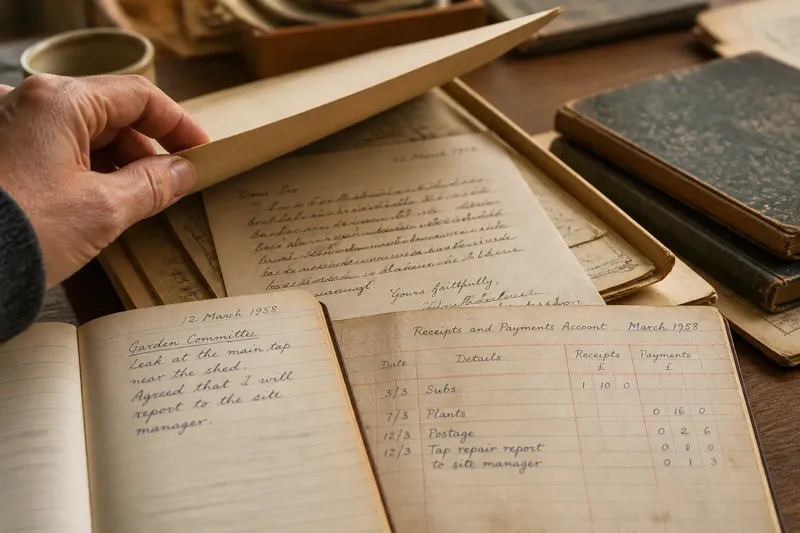
A committee member opens an old folder to find out why a letter was sent to the council. The minutes are missing, but a copy of the letter, a dated notebook entry and an account-book note each offer a different clue. Before meeting minutes became familiar, groups kept decisions in forms suited to their needs and circumstances; those surviving records are not all the same kind of account.
Earlier records served particular purposes
There is no single story of what every group kept before it had regular minutes. The documents that remain vary by place, period and organisation. A letter might communicate a decision to someone who was absent. An account book could record money received or spent. A petition could set out a request, while a personal notebook might preserve one participant’s recollection.
These examples are evidence of different record-keeping tasks, not proof that every group used the same methods or kept a complete account of its meetings. A document can show that a choice was communicated or a payment entered without revealing everything said in the room.
That distinction matters when reading old records. A letter is written for its recipient; a ledger is organised around transactions. Neither necessarily captures the full discussion behind an outcome. Treat each item as a source with a purpose, rather than as a missing version of modern minutes.
Choose a record for the job it must do
For a group today, the useful question is not which format looks most official. Ask what a future reader will need to understand, and how much context the decision calls for.
- Observation: The arrangement affects only people present and is easy to recall. If no follow-up or wider explanation is needed, then a brief shared note may be enough; otherwise, record the outcome and who needs to know.
- Observation: Several tasks will continue across meetings. If members need to see what is open or complete, then use a dated running log; otherwise, a one-off note avoids maintaining an unnecessary tracker.
- Observation: People who were absent need the result. If they must understand the outcome, then circulate a written account; otherwise, keep the record with the group’s usual files.
- Observation: The choice affects the group’s ongoing responsibilities. If later members will need its context, then make a fuller record; otherwise, keep the account focused on the decision and next action.
- Observation: The group must be able to retrieve records over time. If its agreed rules call for approved minutes, then maintain them in a consistent archive; otherwise, choose a simpler format that still lets members find the record.
- Observation: A draft contains private details not needed to explain the outcome. If those details do not belong in the shared account, then omit them or follow the group’s privacy procedure; otherwise, retain only the relevant context.
Say a residents’ group has a dated note saying it will ask the council about a damaged path sign, and one volunteer is to draft the message. If that is the whole task, the note may be all the group needs. If the group is also tracking several unresolved requests, a shared log makes their status easier to see. The trade-off is straightforward: the note is lighter to maintain, while the log gives a broader view of ongoing work.
Minutes help when a group needs continuity
A recurring group often benefits from a consistent record because members change and decisions can remain relevant after a meeting ends. A date, meeting name and clear outcome make the account easier to retrieve. A record can also distinguish an agreed decision from an idea raised for later discussion.
Minutes need not reproduce every comment. A useful account gives enough context to explain what the group decided, while avoiding claims about what everyone felt or intended. For example, “The group agreed to request a repair” describes an outcome. “Everyone supported the proposal” should appear only if that accurately reflects what happened.
Use a simple template when it helps members find the same details each time:
- The group’s name and meeting date.
- The decision, written in plain language.
- Any condition or context needed to understand it.
- Follow-up actions and the person or role responsible.
- Questions left open or referred elsewhere.
- Whether the record is a draft or approved version.
Keep records somewhere members can access without creating a tangle of competing copies. A paper minute book may suit an in-person group; a shared folder may work for members who meet remotely. Use clear filenames and follow the group’s procedures for access and retention. For formal organisations, check the rules that apply to them.
How should a group handle different kinds of records?
Can a letter count as a record of a decision?
A letter can show what was communicated to its recipient, but it may not explain the full discussion or how the group reached its choice. Keep it alongside minutes or notes if that context matters.
Is a ledger the same as meeting minutes?
No. A ledger is generally organised around entries such as money or goods, while minutes record a meeting’s business. A ledger may support an account of events, but it does not necessarily show why a decision was made.
What if the old paperwork gives only part of the story?
Describe what the documents do show and what remains unknown. Avoid filling gaps with assumptions; if the question still matters, ask the group to clarify it and record the clarification as a new account.
How should a group label an unfinished record?
Mark it clearly as a draft and keep that label until the group’s agreed review process is complete. This helps readers distinguish a working copy from an approved account.
A worked example shows how formats differ
Imagine a fictional gardening group receives a note that a shared tap is leaking. At its next gathering, members decide that one volunteer will report the problem to the site manager, but they do not choose who will buy replacement equipment. The starting information is the note about the leak and the group’s stated decision; no repair outcome is yet known.
The note is first dated and filed with the group’s papers. The volunteer’s name and the agreed report are then entered in the minutes, while the equipment question is marked as unresolved rather than described as a decision. If the group is already tracking several maintenance jobs, the same report is added to its running log as an open task. The resulting records let a later member see that a report was assigned, that no purchase was agreed, and that the maintenance task remains open. The minutes explain the meeting; the log makes the continuing work easier to locate.
Make records useful to the next person
Before filing an account, ask whether someone who missed the meeting could tell what happened and what remains open. If not, add the missing decision, context or action, rather than trying to recreate every remark.
For a search about meeting minutes, the practical choice is to match the record to its purpose: a letter communicates, a ledger tracks entries, a log follows ongoing work, and minutes preserve meeting business. Keep the record modest enough to maintain and clear enough that a new member can use it without relying on someone else’s memory.